

Think about the last time you sat through a long, dull meeting — your leg bouncing under the table, a pen clicking in your hand, maybe your eyes drifting off to doodle in the margins of your notebook, all without you even noticing. None of this strikes us as unusual. We've been doing it, and watching others do it, for so long that it's become invisible.
Your child is doing the same thing. The hand-flapping, the rocking, the humming — in the neurodivergent community, this is called "stimming," and it isn't defiance or randomness- it's regulation. The only real difference between your child's stim and your own foot-tapping is that one's had years to be normalized, and the other hasn't. I say this because if you've watched your child do this in public and felt a knot of protectiveness, embarrassment, or worry — that is real, and it doesn't make you a difficult parent. It makes you a parent paying close attention, in a world that hasn't quite caught up to your child yet.
What I hear from parents
Here's the part I want to be honest about. Most parents who reach out to me aren't looking to understand their child's regulation just yet — they're hoping I can help make it stop… quickly. Often there's a school function coming up, or relatives visiting, or just a regular outing to a restaurant or a park, and underneath it is that quiet, familiar pressure — log kya sochenge — what will people think. For a parent still trying to understand the diagnosis itself, this is even harder. I've sat with mothers who weren't really upset about their child snapping his fingers and giggling at a family gathering — they were upset about one raised eyebrow from an aunt, and what it made them feel about themselves.
I don't dismiss that. Stigma isn't imagined, and I know that it costs something real — especially where a child's behavior so often reflects on the whole family. But my job was never to make your child look more "typical." It's to help both of you — and those aren't always the same thing.
What adults with Autism themselves say
It's worth pausing on the other side of this too, because researchers have actually asked adults with Autism about their own experience of stimming, and it's hard to ignore what they said. In interviews, many described a whole range of difficult emotions — anger, frustration, shame, confusion — tied to specific memories of being told to stop (Kapp et al., 2019). Others spoke about how much effort it takes to hold a stim in, and how that effort quietly drains attention and energy they needed elsewhere — in a lecture, in a conversation, in just getting through a day (Charlton et al., 2021) .
What comes through just as strongly is how many different functions stimming was serving them — not just one. For some, it was about calming down when the world felt like too much: noise, lights, too many people at once. For others, it worked the other way — helping them feel more alert and engaged when a room felt flat or under-stimulating. Several described specific movements tied to specific emotions— something the people close to them learned to read over time, as another way of knowing how they were feeling. Others said certain stims helped them concentrate through a demanding task, giving them one small, controllable thing to hold onto in a much bigger, harder-to-control environment. And more than one person made a simpler point that's worth remembering: sometimes it wasn't coping with anything in particular- it was just enjoyable (Morris et al, 2025).
A few made a point I think about often: take away someone's way of coping without offering anything in its place, and what fills the gap usually isn't calm — it's a different, less helpful behavior, or the same one, just hidden (Charlton et al., 2021; Collis et al., 2022) .
That's the part that's easy to miss from the outside. Asking a child to simply stop is rarely neutral. It has a cost, even when we can't see it.
The question I ask myself
When a repetitive behavior comes up in session, the question isn't "how do we stop this." It splits into two very different paths:
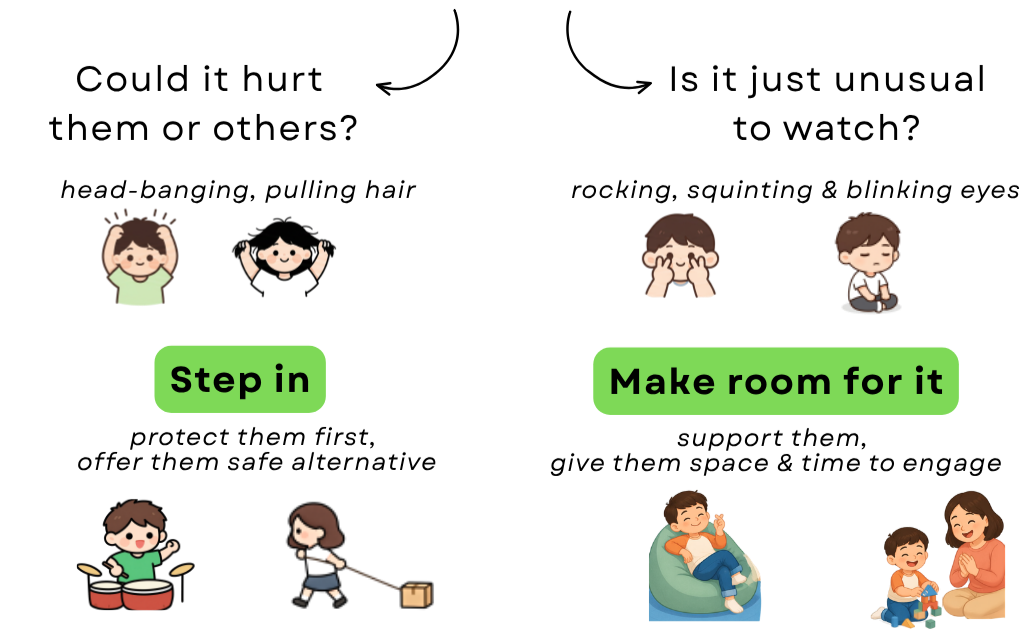
Stepping in is important, not because the behavior is wrong, but because my first responsibility is to keep your child safe. I want to be clear about this distinction, because it gets lost too often: stepping in for safety is not the same as trying to eliminate stimming. It never should be.
What actually helps, when safety is a concern
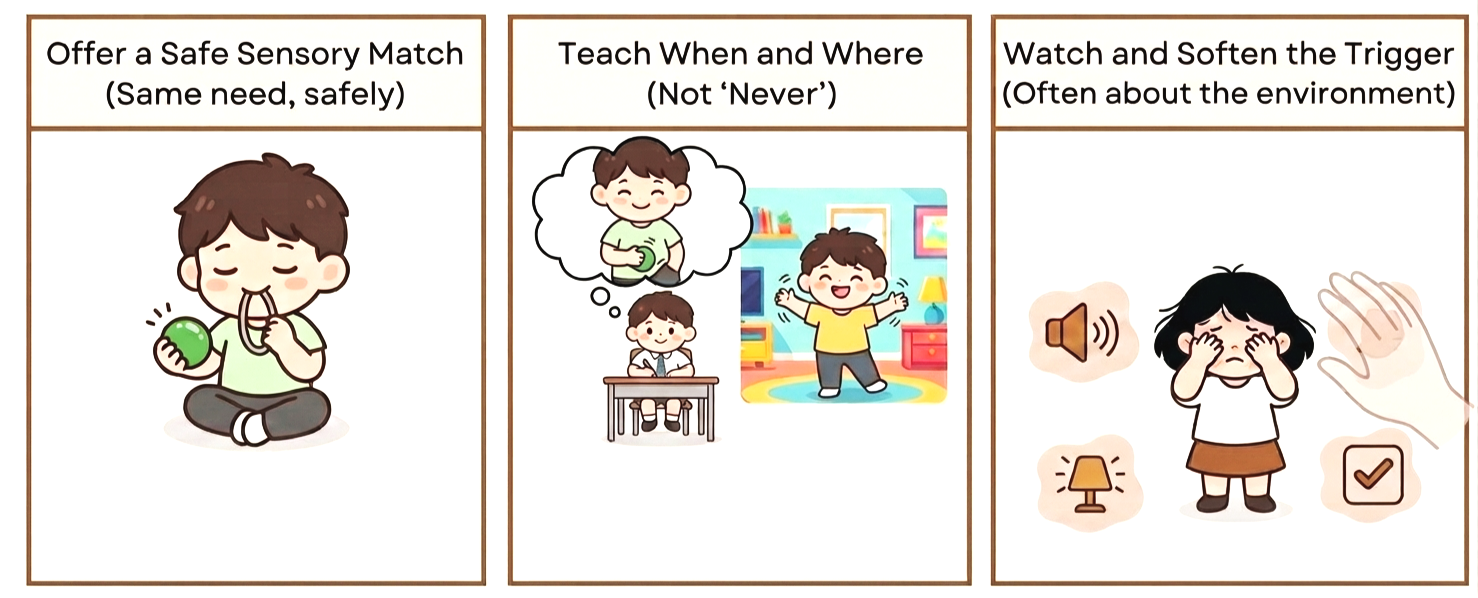
I once worked with a young boy who would bite down hard on the sides of both his hands whenever his classroom got too loud — group activities, birthday celebrations, fire drills. His biting seemed to be his body's own way of coping with the noise — the deep pressure of it seemed to counteract how overwhelming the sound had become. Punishing that, or simply pulling his hands away, was never going to change what his body needed in that moment. What helped was finding him something else that met the same need before his hands ever went to his mouth — a chew-safe tool he kept in his pocket, and a quiet corner he could go to when things got overwhelming, one he didn't need permission to use.
This is where most of the practical work lives, and it's worth spending real time on:
As they get older, let them decide
This part matters more as a child grows. Once a child, teenager, or adult can reflect and communicate in some way — even a small way — the most respectful thing we can do is ask, rather than decide for them: what actually helps you feel calmer? What would you rather reach for, if biting your hand isn't safe? Sometimes that means trying a few options together and letting them tell us, in whatever way they communicate, what genuinely works and not assuming we already know. Their assent matters here, not just their compliance. It's not only kinder; it teaches something we want them to carry forward long after we're not in the room: the skill of noticing what their own body needs, and problem-solving it for themselves.
What doesn’t help
Scolding, slapping a hand away, forcing “hands down,” shaming a child in front of others — none of this teaches regulation. It only teaches a child to hide what they're feeling, which tends to show up somewhere else later, usually somewhere you can't see.
Before I close
If you're still trying to understand your child's diagnosis, or not yet sure about what stimming means for your child's future — that's allowed. Acceptance isn't a single conversation or a single blog post. It's something you'll keep arriving at, in pieces, over years, the same way I keep arriving at it in my own practice. My hope isn't that you feel resolved by the end of this. It's that the next time you see your child rock, or flap, or hum, you have one more way of seeing it — as your child's way of coping, in a body working hard to make sense of a loud world. That's worth some patience.
References
Charlton, R. A., Entecott, T., Belova, E., & Nwaordu, G. (2021). “It feels like holding back something you need to say”: Autistic and non-autistic adults’ accounts of sensory experiences and stimming. Research in Autism Spectrum Disorders, 89, 101864. https://doi.org/10.1016/j.rasd.2021.101864
Collis, E., Gavin, J., Russell, A., & Brosnan, M. (2022). Autistic adults’ experience of restricted repetitive behaviours. Research in Autism Spectrum Disorders, 90, 101895. https://doi.org/10.1016/j.rasd.2021.101895
Kapp, S. K., Steward, R., Crane, L., Elliott, D., Elphick, C., Pellicano, E., & Russell, G. (2019). ‘People should be allowed to do what they like’: Autistic adults’ views and experiences of stimming. Autism, 23(7), 1782–1792. https://doi.org/10.1177/1362361319829628
Morris, I. F., Sykes, J. R., Paulus, E. R., Dameh, A., Razzaque, A., Vander Esch, L., Gruenig, J., & Zelazo, P. D. (2025). Beyond self-regulation: Autistic experiences and perceptions of stimming. Neurodiversity, 3. https://doi.org/10.1177/27546330241311096