

Why Connection Comes Before Compliance
Every parent has been there.
You call your child's name. Nothing. You ask them to come over. Silence. You repeat yourself, hoping they'll respond this time. Sometimes they do, but often they stay exactly where they are, completely absorbed in what they're doing. It's easy to wonder-, "Why won't they engage with me?" But often, the answer isn't that they don't want to interact, it's that we haven't yet become more interesting than whatever already has their attention.
This is where pairing comes in.
Pairing is about building a genuine connection before we expect anything in return. Before asking a child to learn, listen, or follow instructions, we first become someone they enjoy being with. We join their world instead of immediately asking them to join ours.
I've come to realize that effective teaching starts long before introducing learning goals. It begins with the relationship. When a child enjoys being with you, they're more likely to seek you out, share experiences with you, and eventually be open to learning from you. For me, pairing isn't just the beginning of a session, it's the foundation of effective teaching. Before I ask a learner to follow my lead, I first want to become someone they're excited to follow.
This isn't just an approach for therapists; it's something every parent and caregiver can use in everyday moments. Whether you're playing with bubbles, reading a favourite book, building with blocks, or simply sitting alongside your child, these shared experiences help build trust and connection.
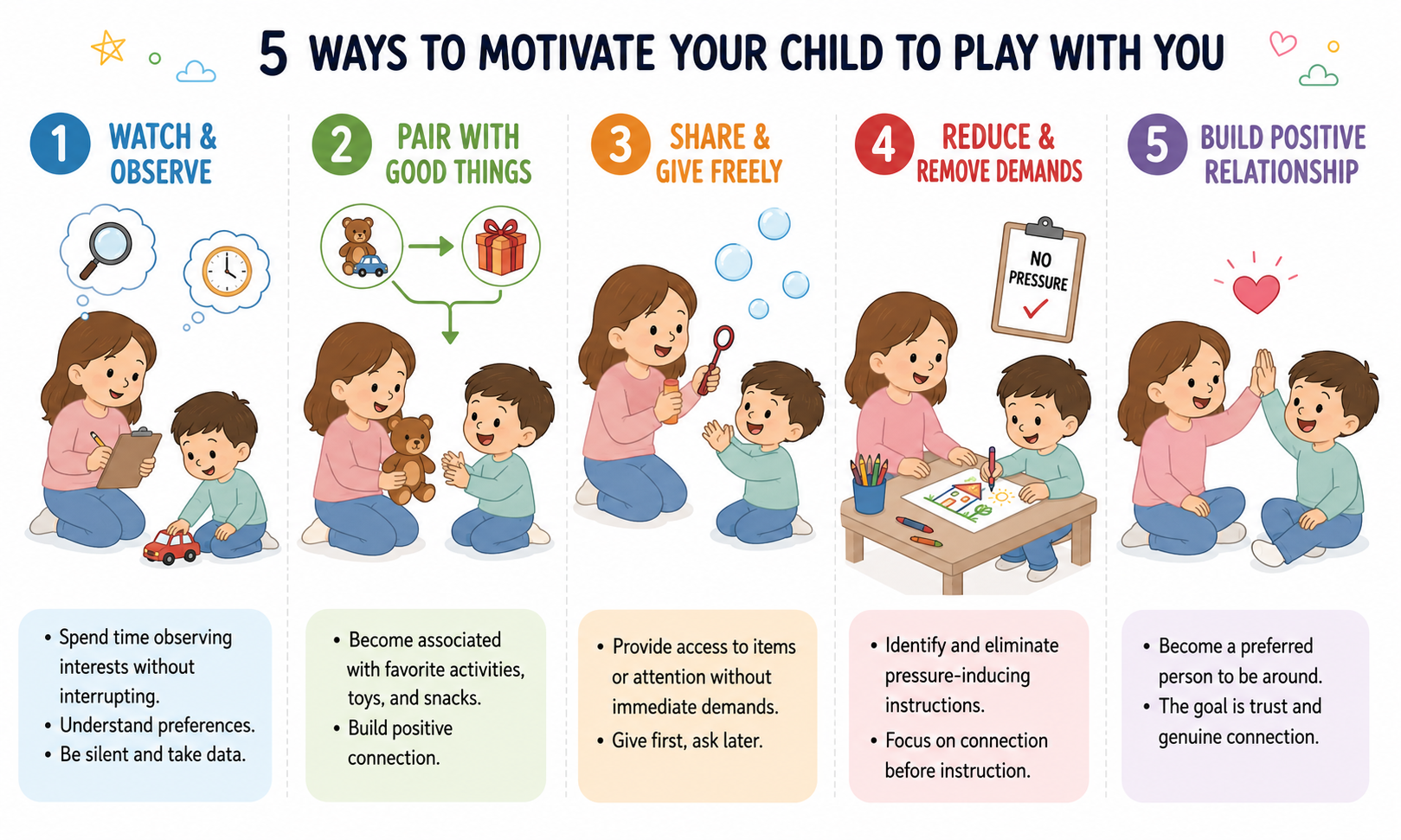
5 ways to connect through their play
1.Watch before you join
Maybe they're lining up cars, flipping the same page in a book, or watching the fan spin-, don't redirect, just sit close and join in on what they enjoy . If they line up cars, line up one beside theirs. No questions, no teaching, just you, quietly in their world, showing them that good things happen when you're near.
2.Follow, don’t lead
Once you know what they're into, join them there. Get on the floor. Pick up the toy. Watch what they're watching. You're entering their world, not inviting them into yours.
3.Give freely
Hand over preferred items, activities, access with zero conditions. No "first do this." No "good sitting." Just give.
4.Put the demands away — all of them
This is the part most people underestimate. Even gentle phrases like "wait," "look at me," "come here" can feel like pressure to a child who hasn't yet learned to trust you. During pairing time, skip them entirely.
5.Be the giver, not the taker
Your child should walk away from every interaction with you thinking: "This person adds good things to my world, not someone who cuts into my play."
Two Ways to Create Connection Moments
Once you're in pairing mode, you'll find yourself doing one of two things and both are valuable.
Capturing motivation:
Keep one eye out for what your child creates on their own. They pull out the blocks, stop at the window to watch the rain, or reach for a favourite toy. Follow the activity, not the child. Position yourself beside it, not opposite it. If they're pushing a button on a toy that lights up or makes a sound, press a different button on the same toy without saying anything. Watch for the small signs that they're inviting you in: a glance at your face, a pause before pressing it again, or waiting to see what you'll do next.
In this video below, the therapist notices the learner turning towards her, recognises it as an indication that he wants the color drop and responds by offering it to him. By following his lead instead of directing the play, she captures the motivation that was already there.
Contriving motivation:
Pick an everyday snack time, bath time, or getting dressed—and add a little fun. Use a silly voice, count "3...2...1..." before a tickle, or make bubbles appear like magic. Be part of the fun, not just the person running it. You'll know it's working when your child laughs, looks back at you, or waits for you to do it again.
In this video, the therapist does this with squeezes. She gives gentle squeezes freely, without placing any demands, allowing the learner to enjoy the experience first. As the motivation for squeezes grows, the learner naturally begins to request more. Rather than asking for communication first, the therapist builds the motivation to communicate.
The Bigger Picture
Here's the thing about pairing that often gets lost in the clinical language around it.
It's not a technique.
It's not a phase you get through so you can start the "real" work.
IT IS THE REAL WORK.
It's the foundation everything else is built on and it never fully stops. Every time you show up for your child without an agenda, every time you give something without asking for anything back, every time you follow their lead instead of pulling them toward yours, you're pairing. You're building the kind of relationship where learning doesn't feel like a fight, where your voice carries weight, and where your child genuinely wants to be in the room with you.
“No strategy in the world works as well as being someone your child trusts.”