

Screen-Free Plate: Guiding Children to Mindful Eating
“A mother sighed during one of my client’s session: ‘How much longer should I wait? My child won’t touch chapati or rice unless I put on CoComelon or YouTube shorts. At least, he isn’t going to sleep on an empty stomach”
While this may seem like a harmless solution to avoid tantrums and ensure children are fed, it can have unintended consequences. A recent study in Rajkot found that over 81% of kids under ten years need mobile screens during meals; researchers warn that this impairs sensory engagement, nurturing a robotic, detached eating style—at the expense of nutrition, social development, and even eye health. A 2025 meta-analysis of Indian studies estimated mean daily screen time of 2.22 hours among children under five years old—about double typical recommendations. The Indian Academy of Pediatrics (IAP) recommends no screens under 2 years, and less than 1 hour per day, supervised for ages 2–5. Most of us- adults remember family meals centered around conversation, connection, and mindful eating. Today, though, mealtime looks different—screens are often present, and food becomes incidental. This shift isn’t just about convenience—it is changing how children perceive eating, hunger, and reward.
But first, let me say this: I truly understand why parents resort to screens during mealtime. Parenting is hard, and feeding children can be one of the toughest parts of the job. There’s no judgment here—many families are facing the same challenge. But it helps to step back and look at why this habit of screen-time eating can create difficulties for your child in the long run.
How Screen Time Affects Eating Behaviors
1. Children Lose Touch With Hunger and Fullness Cues
Young children are naturally intuitive eaters. They eat when they’re hungry and stop when they’re full. Eating while distracted by a video means kids are no longer paying attention to their own body. They don’t notice when they’re hungry or when they’re full. Over time, this can lead to overeating, undereating, or eating just because the screen is on.
Example: A child may refuse to eat without a cartoon—even if their stomach is growling.
2. The Screen, Not the Food, Becomes the Reward
Ideally, the natural reward for eating should be the taste and satisfaction of hunger. But with screens, the reinforcement flips—children eat to keep the video going. This makes meals dependent on entertainment rather than appetite or nutrition.
Example: “One more bite, and I’ll play the next video” turns food into a chore. A child who is only given a phone while eating will eventually refuse to eat without it, as they associate food with watching videos rather than hunger.
3. Social and Emotional Learning Opportunities Are Missed
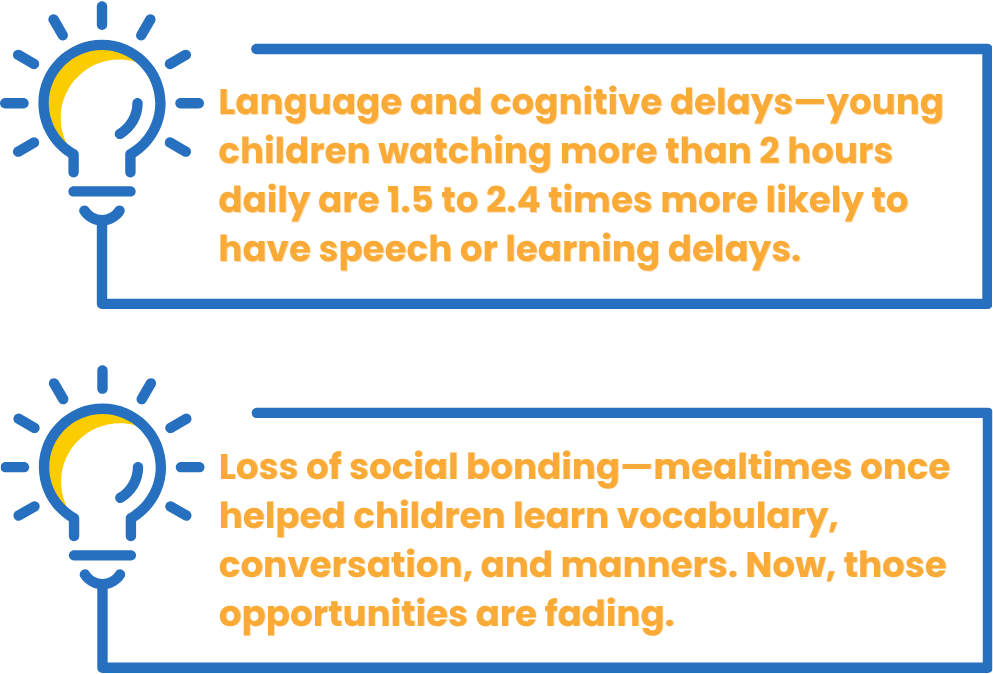
Mealtimes are not just for nutrition—they’re also for bonding. Conversations at the table build language, emotional connection, and family culture. With a screen in the way, those rich opportunities are lost. Beyond eating habits, excessive screen use affects developmental domains:
4. Picky Eating and Restricted Diets Increase
Children learn to enjoy a variety of foods through exposure. When they don’t pay attention to what they’re eating, they miss out on exploring flavors, textures, and smells. This can lead to food refusal, as they haven’t truly engaged with their meals. This also limits exposure to new foods, often leading to picky eating or refusing entire food groups. Also, if screens are used as a bribe (“If you eat your vegetables, you can watch a video”), children may develop negative associations with healthy foods.
Example: A child may eat vegetables while distracted but reject them later because they never truly tasted them or because they aren’t used to paying attention to their food.
5. Daily Routines Get Disrupted
If eating only happens with screens, children may delay meals or skip them if a screen isn’t available, leading to irregular eating patterns. This, in turn, impacts sleep quality, digestion, and energy levels, making them more irritable or lethargic throughout the day, creating a ripple effect on overall well-being.
Example: A skipped dinner because the phone battery died may lead to late-night hunger and restless sleep. And a child who doesn’t eat breakfast because they don’t have a screen available may experience fatigue and difficulty concentrating in school.
Why This Becomes a Cycle:
Many parents unintentionally reinforce screen-dependent eating. Here’s how:
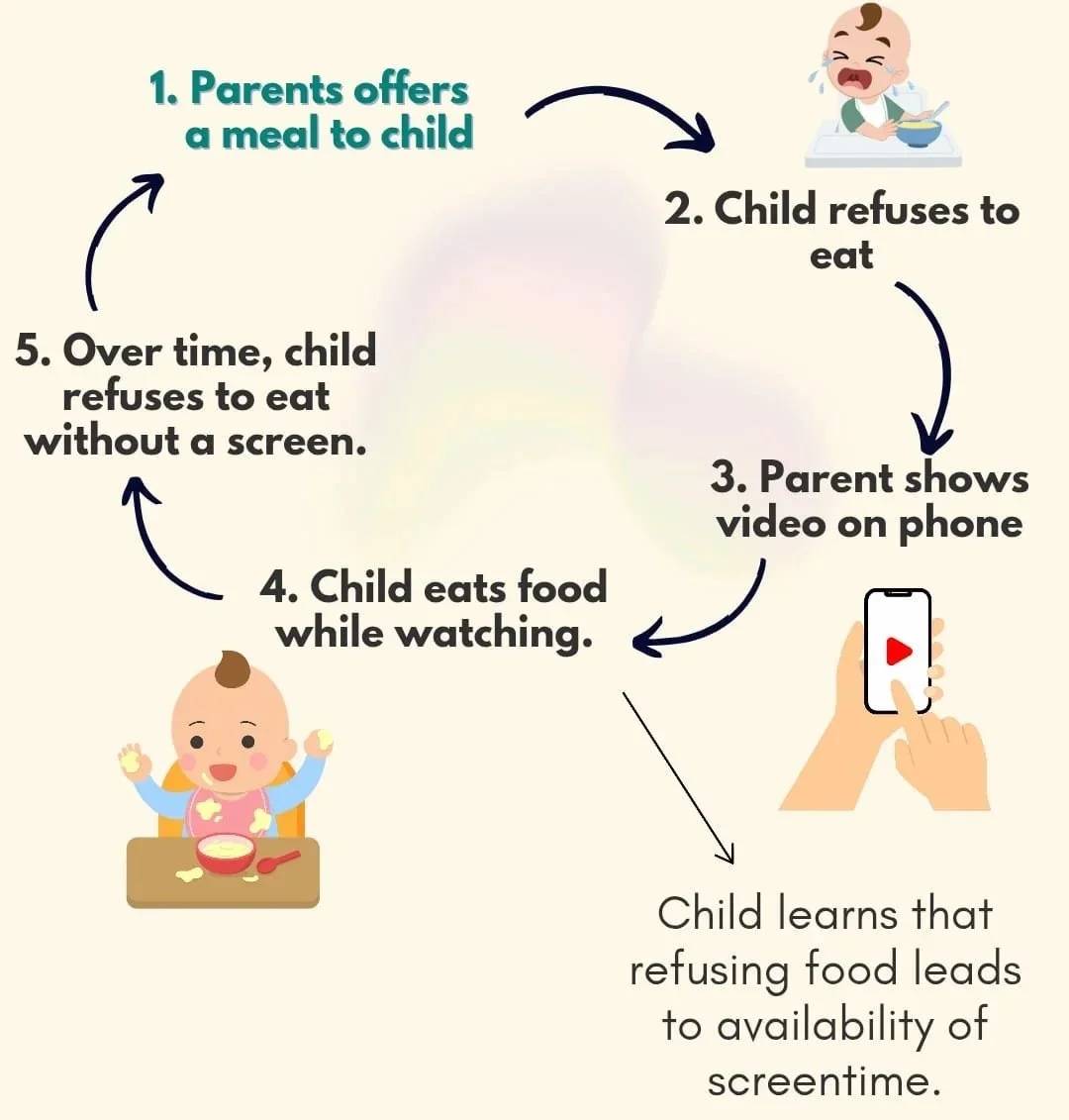
Breaking this cycle requires a gradual shift—removing screens at mealtimes while replacing them with positive, engaging alternatives.
I know this may sound worrying—and yes, feeding kids is a really tough gig. Just like that parent who turned to CoComelon, you’re doing what you can to avoid a struggle. But the good news is, with a few practical changes, you can gently guide your child back to healthier eating habits. Changing this takes time—and gentle consistency.
How do I develop healthy eating and mealtime habits?
Establish Predictable Mealtime Structure:
Keep regular times for meals and snacks.
Eat in the same place (preferably away from screens), with the same start and end cues (e.g., “Let’s sit at the table—it’s mealtime!”).
Replace Screens with Sensory Engagement
Narrate meals (“Look how soft your fish/chicken/veggies are today!”).
Use colorful plates or fun shapes in rotis.
Ask sensory questions—“Is your curry salty or spicy?”
This helps bring attention back to food, reinforcing eating itself.
Reward the behavior without Screens
Praise gently: “You tried that chapati all by yourself—I’m proud of how patient you are.”
Use sticker charts or allow a small story/dance/song together after meals as rewards—not videos.
Encourage Food Exploration, Not Pressure
Research shows that children may need 10–15 exposures to accept new foods.
Offer variety, let them touch or explore textures, let them choose or mix small portions.
Offer without pressure—“You can eat a little, or just play and sniff it—no worries
Gradual Weaning from Video Dependence
Start by limiting screen to the first 5 minutes of meals, then switch to conversation.
Gradually reduce video time each day.
Replace the screen moment with something interactive—like asking a “What sound does your food make?” question.
That parent’s relief—‘At least he’s not sleeping hungry’—reminds us how challenging this is. But with small, patient changes, mealtime can become about connection again—not distraction.”

References
Indian Academy of Pediatrics. (2022). Guidelines on screen time for children under 5 years. Indian Pediatrics, 59(4), 350–356. https://doi.org/10.1007/s13312-022-2638-5
Khobragade, A., & Shenoy, R. (2025). Screen time among under-five children in India: A systematic review and meta-analysis. Journal of Family Medicine and Primary Care, 14(1), 45–54. https://doi.org/10.4103/jfmpc.jfmpc_1234_24
Kulkarni, P., Deshpande, R., & Patel, M. (2024). Association of screen-time with pragmatic development among Indian toddlers aged 1–4 years. Journal of Developmental & Behavioral Pediatrics, 45(3), 210–219. https://doi.org/10.1097/DBP.000000000000123
Saurashtra University. (2025). Study on screen dependency during mealtimes among children under 10 in Rajkot. Saurashtra University Research Bulletin. [Press release/Report]
Semar, H., Jha, P., & Thomas, R. (2022). Correlation of screen time with eating behaviors and inactivity among school-aged children in India. Journal of Clinical & Diagnostic Research, 16(12), SC10–SC14. https://doi.org/10.7860/JCDR/2022/62014.17329